
'Drive' - A New Favorite
- Nick Kaufman
- Mar 28, 2021
- 4 min read
Released in 2011, 'Drive' was hailed as one of the best films of the year by critics and enthusiasts alike. The film stars Ryan Gosling at an apex of his career, which he starred in 'Crazy Stupid Love' and 'The Ides of March' the same year 'Drive' was released. The film has heart, violence, and a purposeful drive (pun intended). After a prolonged hesitation to my initial viewing, my expectations were completely subverted leaving me in a state of awe and euphoria.
'Drive' begins right off with one of the most engagingly intense scenes in recent memory. Our anonymous protagonist (Ryan Gosling), later referred to as the Driver, discusses on the phone with a client about a job he's going to pull. It is clear from his conversation that the Driver has a lot of experience as a getaway driver given his high levels of meticulous planning. The scene that follows confirms this as he taps into a police radio, sets up a watch for the time, and oddly turns on the radio for an NBA broadcast. Each piece comes together creating a flawless getaway, which introduces the moonlight occupation of the Driver and how astute he is. After the scene, the opening credits start introducing the iconic soundtrack and the beginning of the movie.
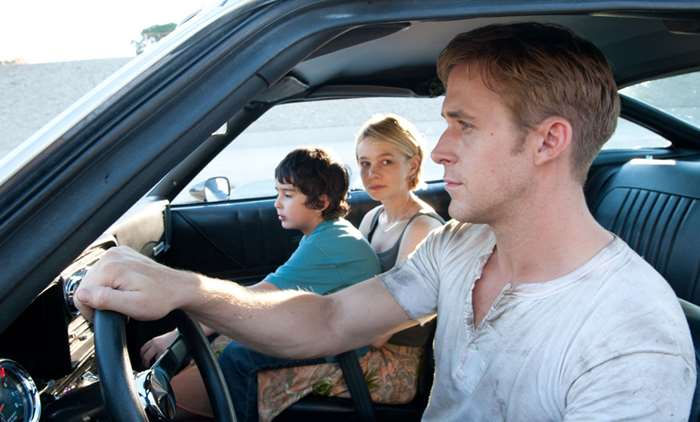
From here the movie takes a step back, a potential romance begins between the Driver and his neighbor Irene (Carey Mulligan). The idea behind the romance is to ground the Driver; bring him back to something enjoyable in his life away from crime. The Driver is so charming and likable in these scenes that it's hard to not fall in love with him alongside Irene. He shows compassion, humor, care, and most importantly he gets along with her son. There are these great, cute scenes with the two of them that melt your heart only to pull it away from you when the film reveals Irene's husband Standard (Oscar Isaac) is back from prison. Standard begins subtle conflicts with the Driver and is later revealed to be in debt to some gangsters before his incarceration. When Standard is forced into a robbery, the Driver has to decide to assist him with his expertise or continue with his quiet life. Simultaneously, the Driver's boss/mentor Shannon (Bryan Cranston) is getting the Driver involved with two hardened criminals, Nino (Ron Pearlman) and Bernie (Albert Brooks). These criminals want the Driver to participate in competitive races to earn themselves cash, which, again, conflicts with the Driver's current motivation to move away from the criminal world. Eventually, both of these stories converge, placing the Driver in a multitude of horrendous situations.

The film is divided into three main acts. The Driver's criminal exit, his re-entry, and his resolution. Each flowing right into the next with ease keeping center focus always on the Driver. His interactions with each character peel back several layers of his personality: with Irene, he demonstrates love, with Standard he shows empathy, with Shannon he has loyalty, and with Nino/Bernie he is cold and ruthless. A profoundly dynamic character is the base of a great film; movies like 'Goodfellas', or 'Moonlight' have characters that change and progress with the overall narrative, and 'Drive' is no different.
After I finished the movie, I sat in my chair and processed every event and scene that transpired in the film. I knew almost instantly that this would be one of my top favorite films. One main reason I got into film and film analysis is because of the subtle, symbolic meanings that are littered throughout most films. In 'Drive,' every scene has something that adds to the overall narrative and the subtextual narrative. Whether it's through music, imagery, or dialogue, 'Drive' is very precise on what it wants to convey. Although some plot points may come off as sudden to some viewers, further analysis and thought justifies every action within the film.

As the story begins to rapidly ramp in intensity, the actions of the Driver become more questionable; but always grounded by a deep, believable motivation. The themes of what it means to be a 'real human-being and a real hero,' which is expressed in the movie's main score A Real Hero, are explored and developed throughout the film. A Real Hero plays twice, the first is the initial romantic scene between the Driver and Irene; the second when the movie concludes. Both times the song plays reflecting on the person the Driver wants to be; while in-between the playing's of the song, the Driver is heading steadily towards a person he doesn't want to be. The addition of this is intentional; the film wants us to question and observe the essence of Driver's humanity. The line between good and evil is always thinner than it seems in 'Drive.' When the Driver and Bernie first meet, the Driver doesn't want to shake Bernie's hand because the Driver's hands are dirty; Bernie responds saying, "So are mine." Another moment is when the Driver is watching a movie with Irene's son. The Driver asks her son if one of the characters is a bad guy, the boy responds with a no because it's a shark, which Driver asks "Are there no good sharks?" Both scenes of dialogue carry meanings reflecting on the Driver's moral ground. It is a reminder to the audience that despite his charming nature, he is still apart of the criminal world. He has been apart of just as many bad things as Bernie, despite beginning to reform his life.
There are dozens of more meanings in 'Drive' that are inexplanable without giving away spoilers. All the underlying symbols reflect deeply on each character's actions and motives. When watching this movie take note that every shot and every line of dialogue has a meaning that builds on the narrative. The acting from Gosling is otherworldly, the cinematography is brilliant, and the music is uplifting and meaningful. I recommend this movie to people who appreciate strong character development and can stomach some graphic violence. Let me know what you think in the comments below.


Comments