
'La La Land' - Analysis and Discussion [Spoilers]
- Nick Kaufman

- Apr 10, 2021
- 5 min read
Updated: Apr 12, 2021
The fact that a musical is a top favorite film of mine is unfathomable. Music has surrounded my whole life, but I have a limited connection with it. Damian Chazelle, director of 'Whiplash' and 'La La Land' conveys the idea that musicals are not limited to the word and can mean far more than that. While watching his films I appreciate his nuanced values on music in and out of the picture. 'La La Land' taught me to seek beyond my personal bias and explore an unknown territory filled with charm and beauty. It took my admiration of Chazelle and Gosling to even tune into the film, which frustrates me because of how great it is. This film has every aspect of a flawless film: perfectly utilizing the necessities of sound, cinematography, editing, and storytelling to produce a highly engaging, cathartic experience.
For those who don't know, 'La La Land' centers on an aspiring musician, Sebastian (Ryan Gosling), looking to open his jazz club, and a struggling Hollywood actress, Mia (Emma Stone). Both are simultaneously pursuing big dreams but struggle to make it far in fulfilling them. After bumping into one another during several coincidental occasions, their differences pull them together into a realistic, charming romance. Gosling and Stone give these performances their all, which truly elevates the film's engagement. The characters have a lasting connection that shows how a partner can completely change someone's life. Eventually, they become more enthusiastic about each other's dreams, which ends up costing their own. The result is a mutual split. Mia and Seb acknowledge that they will always love each other but part ways to pursue their respective dreams.

Although at first glance 'La La Land' can come off as quite simplistic, it is a character piece with complex ideas and thoughts. 'La La Land' is an outlier in the sense that every facet of filmmaking harmonizes with one another to expand upon the present narrative with subtlety and brilliance. The music is a prime example of this. Since the music is diegetic (audience and character listen and experience together), the film becomes more immersive because we share every experience with the characters. The songs not only tell the story but reflect on themes of hopes and dreams. The opening score, Another Day of Sun, mirrors the perception of an ideal life with the internal struggle from the characters.

This idea becomes apparent as the audience learns more about Seb and Mia as characters. Both of them desire to be three or four steps above what they are but are held back by a lack of devout ambition. Seb is weighed down by his restaurant pianist gig and Mia is restrained by the feeling of being talented, despite her lack of success. In the second song, Someone in the Crowd, Mia is surrounded by Hollywood glamour with the music shifting between loud and euphoric to quiet and alone.

It is because of the music that audiences connect with Mia and Seb without even knowing that they are. During the final portion of the film, audiences are taken through an ideal rendition of what their relationship could have been. The music that plays throughout the scene summarizes every prior event culminating into the most cathartic moment in the film. After seeing a rapturous rewriting of history, Seb plays his final notes, they glance at each other, Seb smiles, and the film ends. The saddened playing of their theme, in just seven notes, reminds the audience that what they saw was truly fantasy, which leaves them motionless and quiet.

Moving on from sound, I'd like to breakdown 'La La Land's more noticeable aspect; the visuals and cinematography. Cinematographer Linus Sandgren uses every minute of screen time and every portion of the frame to further the narrative. A considerable amount of the shots are parallel versions of other scenes, sometimes even identical. The shot of Mia working at the coffee shop and later buying from the same coffee shop visually explains the magnitude of her transition towards success. Another subtle set of parallel shots are Mia's three separate driving shots. The first is to show the anticipation of going to the theater with Seb, the second shows the theater closed, which conveys the progression of their relationship, and the final is Mia driving in the reverse direction, which echoes a regression in her character and her aspirations. With no words or obvious visual clues, the story is constantly evolving without the audience being completely aware. The use of parallel visuals is what introduces the audience to Seb and Mia from the start: Seb and Mia are on the same highway, both have people in their lives who say that it is more important to find someone than to pursue their dream, and both characters are shown to have a mental limit that blocks them from achieving true happiness. The execution of the double narrative is impeccable given the amount of predeceasing failures. If you watch this movie after 'Whiplash' Chazelle's cinematography standards become noticeable: the use of whip-pans, appropriate hand-held use, and long take wonders carry the audience through the perspective of its characters. Each technique serves a distinct purpose to heighten distinct emotions. Whip-pans enhance the excitement of scenes, hand-held motions intensifies tension, and long take wonders allow the actors to communicate emotions without dialogue. Each technique, alongside parallel shots, indicate the meticulousness behind every frame.


However, what I think is clearest to the audience is the abundance of color throughout the film. The colors in this film show us the state of characters; expanding upon their dynamic range of emotional points from start to finish. In Mia and Seb's first playful interaction at the pool party, Seb is dressed in red, and Mia is dressed in yellow. The color yellow represents happiness, optimism, idealism, while red represents power and determination. Red and yellow are opposites of each other yet they are attractive. Once their attraction takes shape after the party, suddenly Mia has obtained a red bag, which infers the acceptance of one another's emotions.

The wide range of colors conveys the peak of a character's life. Someone in the Crowd begins with bright, intense colors, Seb's band is made entirely of color, and, of course, their first dance is surrounded by a bluish, Californian night sky. It is not a coincidence that their first and last real moments in their relationship are surrounded by blue. Blue represents trust and loyalty, which despite their breakup is still prevalent between them. These themes are explored during their last dance where it is incredibly beautiful but devoid of color.

The absence of color exemplifies the lack of pursuit in their dreams, passion, and even love. The beauty of color in this ending shows that they aren't together, but it's okay because they love each other and will always be connected.
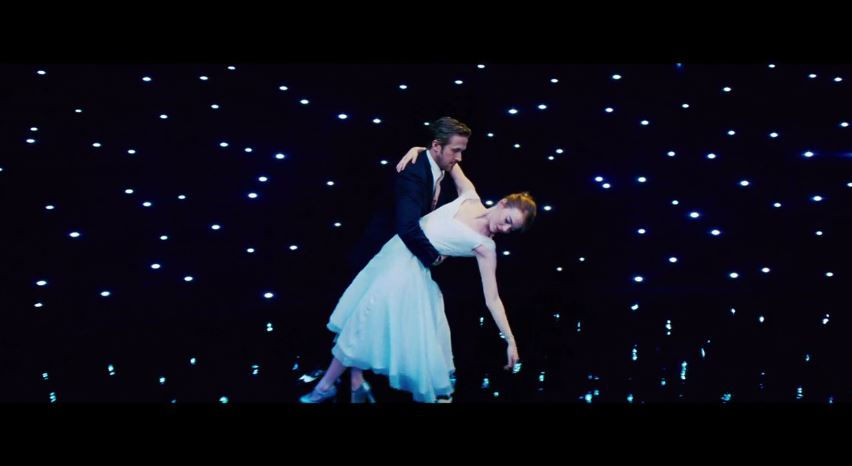
Damian Chazelle is a director of stories that follow one's dreams and ambitions. In each of his movies, characters are tested and challenged on how far they'll go to find success. Following through something that means a lot to a person is a feat to accomplish. He supplements his stories with ingenuity and affection, which is recognized throughout. 'La La Land' stole my heart and blew me away. A film where everything is purposeful and everything has a meaning to the point where it feels jaw-droppingly endless. Music, visuals, and direction are all general aspects that I covered, but there is more to take away from each viewing. I made this piece my first spoiler review because this is a film that deserves it. 'La La Land' is a masterpiece in every sense of the word and I hope you feel the same way.


Comments